Gustaf Morell
The Girl with the Dragon TattooGustaf Morell is the retired detective superintendent who conducted the original formal investigation into Harriet Vanger’s disappearance. His reports, preserved in the case files and later studied by Mikael Blomkvist, give the mystery its most disciplined documentary record. Morell’s importance lies not in solving the case, but in refusing to let an unexplained disappearance become merely an old family sorrow: for thirty-six years, he continued to carry its unanswered questions.
Identity and Background
Morell had retired to Lake Siljan in Dalarna, where he lived as an old policeman still attached to the work he had left behind. He and Henrik Vanger were the same age and had been born on the same day, an irony that linked the investigator and the bereaved relative through the long aftermath of Harriet’s disappearance. The prologue presents Morell waiting with his coffee for Henrik’s annual telephone call about the flower that arrived every November, showing that the case had become a ritual of remembrance as well as an investigation.
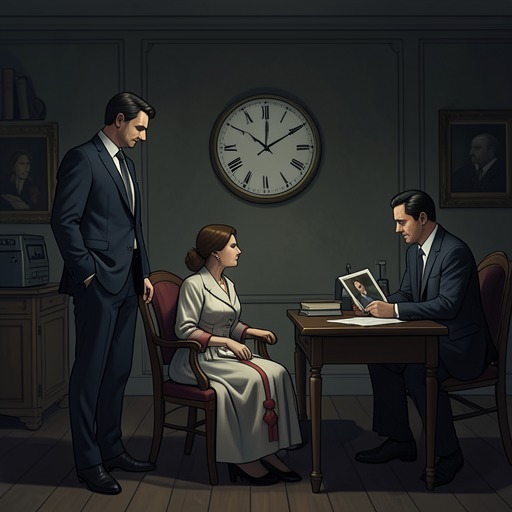
When Morell arrived by boat at Hedeby Island, he took command of the inquiry and prepared a formal report on Harriet Vanger’s disappearance. Unlike the earlier notes, which were filled with abbreviations, Morell’s pages were typed in clear, readable prose. Their objectivity and unusual wealth of detail impressed Mikael Blomkvist, who found in them a record more substantial than the fragmentary shorthand that preceded Morell’s arrival.
The Original Investigation
Morell began by interviewing Henrik Vanger and Isabella Vanger, Harriet’s mother, then questioned Ulrika Vanger, Harald Vanger, Greger Vanger, Martin Vanger, and Anita Vanger. The sequence of interviews suggested an effort to establish the family’s internal hierarchy, moving from the most important figures toward those considered less central. He also recorded that Ulrika had been unable to provide information, having gone to bed early and not seen Harriet for several days, though she insisted that the police act immediately.
The investigation remained unresolved even after experts were summoned from Stockholm. Morell could not determine how Harriet had died, or even prove that a murder had taken place. That uncertainty sharply distinguishes the case from an ordinary homicide inquiry: the investigator was left pursuing an absence, with neither a body nor a confirmed crime to anchor the search.
Morell nevertheless spent years speaking with Harriet’s friends and examining the circumstances of her final year. He noticed that she had changed from a lively teenager into a withdrawn and uncommunicative girl. Her classmates described her as impersonal; she no longer spoke about herself, gossiped, or confided in her friends. Morell treated those changes as possible evidence that something troubling had occurred in her life rather than dismissing them as ordinary adolescence.
Meeting with Mikael Blomkvist
When Mikael Blomkvist drove through the snow to Lake Siljan to meet him, he expected resistance. Morell had spent thirty-six years contemplating the mystery, and Blomkvist was the newcomer retracing the ground where the police investigator had failed. Instead, Morell answered Blomkvist’s questions methodically and without hostility, presenting himself as a patient, schoolmasterly guide rather than a defensive former investigator.
Blomkvist had prepared ten questions based on the report, but eventually admitted that the questions were only an excuse for the meeting. He wanted to know whether Morell had retained a hunch or noticed anything absent from the written account. Morell’s willingness to discuss the case allowed the investigation to pass from an official archive into a second phase of interpretation, in which the journalist could test the old evidence without treating the retired detective as an obstacle.
Morell explained that an unsolved murder can become the loneliest responsibility in police work. Relatives and friends eventually return, however imperfectly, to everyday life, while the officer left with the investigation continues thinking about the victim. His description makes the case’s persistence personal: Harriet remained present for Morell not because the evidence was conclusive, but because the lack of an answer kept gnawing at him.
Harriet Vanger and the Religious Clues
Morell’s inquiry also preserved details that later became crucial to understanding Harriet. He recorded her increasing religious preoccupation during the last year of her life. Harriet had attended Sunday school, said evening prayers, and been confirmed, but she then read the Bible more intensely, went regularly to church, briefly joined a Pentecostal congregation in Hedestad, and afterward began reading books about the Catholic faith.
She did not turn to Otto Falk, the Vanger family’s pastor, even though he was a family friend. Morell considered the pattern significant because no one else in the Vanger family had been noticeably religious and because Harriet’s father had drowned the previous year. He concluded that some event in her life had troubled or affected her, and continued questioning her friends in the hope that she had confided in someone.
The surviving record later connected Harriet’s Bible to a code based on verses from Leviticus. Her notes identified passages concerning sexual transgression, punishment, mutilation, sorcery, and blood, with each verse underlined in the Bible. Morell’s original attention to Harriet’s altered religious life thus becomes part of the evidentiary chain that eventually links her private reading to the murders’ ritualized pattern.
Pastor Falk’s comments further complicated the religious evidence. He spoke of sola scriptura and sola fide, suggested that certain books had not been accepted into the canon, and characterized Harriet as someone drawn to esoteric sources and the Apocrypha. Morell himself is not shown interpreting these theological distinctions, but his interviews preserved the testimony through which Blomkvist and Lisbeth Salander could later distinguish ordinary adolescent religious enthusiasm from a more specific intellectual and emotional crisis.
Investigative Legacy and Narrative Role
Morell’s report gives the mystery a structure of accumulated observation: interviews, behavioral changes, family testimony, and the limits of what could be proved. Later discoveries—such as the first photograph of Harriet on the day of the Children’s Day parade, the recognition that Anita Vanger had been mistaken for Cecilia Vanger, and the Bible’s Leviticus references—do not erase his work. They expose how a carefully recorded investigation can still be constrained by mistaken identities, missing testimony, and the assumptions of those who examine the evidence.
His role is therefore both investigative and memorial. Morell cannot provide a definitive ending, yet his persistence prevents Harriet’s case from disappearing into the family’s private mythology. The annual flower and telephone call shared by Morell and Henrik Vanger turn the unresolved investigation into a repeated act of remembrance, while Morell’s conversation with Blomkvist transfers responsibility for the unanswered past to a new investigator.
Morell represents the ethical burden of incomplete knowledge. He knows that he cannot prove murder, cannot establish Harriet’s death, and cannot force the surviving family to surrender its secrets. Still, he refuses the consolation of closure without evidence. His legacy is the insistence that an absent victim remains an investigative subject, and that the passage of decades does not by itself settle what happened.